7 Hooping Drills That Fix Your Weak Direction
Quick Answer: Your weak direction is not weaker muscles, it is an unpracticed motor pattern plus a different timing relationship between hips and hoop. The fastest fix is not more reps in the weak direction. It is alternating short sets between directions in the same session, so the strong side’s timing information transfers while the pattern is still fresh. Seven drills below, starting with walking the pattern with no hoop at all.
One direction feels like riding a bike. The other feels like the first week all over again.
The frustrating part is that practicing the weak direction alone often does not close the gap as fast as you would expect. There is a better order of operations.

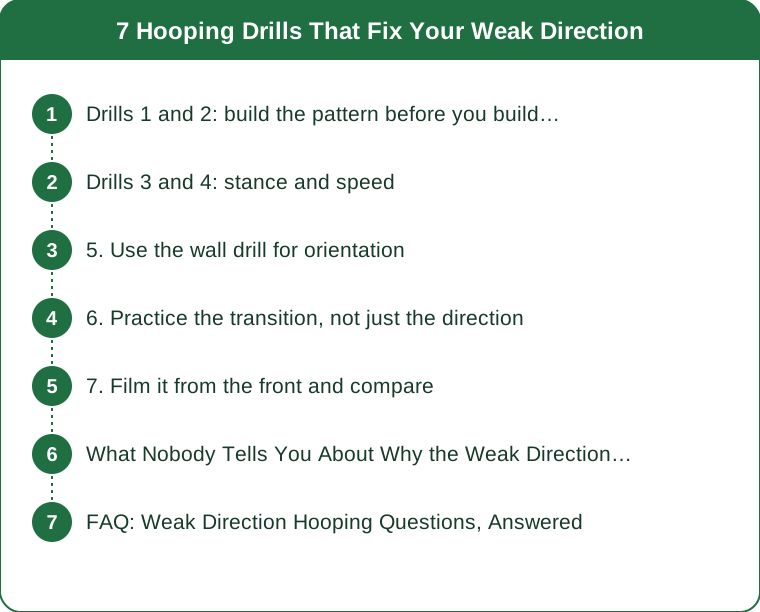
Drills 1 and 2: build the pattern before you build the reps
1. Walk the pattern with no hoop
Start where there is nothing to drop.
Stand and produce the exact hip motion you use in your strong direction, front to back or side to side depending on your style, without a hoop. Feel the rhythm and note which foot is forward, which hip leads, and where in the cycle the push happens.
Now reverse it. Same movement, opposite orientation. Switch which foot is forward.
Do 60 seconds each direction, three times. This is genuinely the highest-value drill on the list and everyone skips it because it looks like nothing.
Why it works: the motor pattern is the hard part, not the hoop. Practicing the pattern without the equipment removes the failure feedback, which is what makes the weak direction feel discouraging. You cannot drop a hoop you are not holding.
2. Alternate short sets rather than grinding one direction
The instinct is to practice the weak direction until it improves. That is slower than alternating.
The structure: 30 seconds strong direction, immediately 30 seconds weak direction, repeat 8 times. Total 8 minutes.
Why it works: motor learning research on contralateral transfer consistently shows that practice on one side improves the untrained side, partly through shared central pattern representations. Practicing the strong direction immediately before the weak one keeps the timing template fresh and available for transfer.
Grinding the weak side alone means you are building a pattern from scratch with a fatigued, frustrated system and no reference.
Keep the sets short. Once the weak direction degrades badly, you are practicing the degraded version. Stop before it falls apart, switch back, and return.
Drills 3 and 4: stance and speed
3. Change your foot stance before you change anything else
Most hoopers have one foot forward and never think about it. In the weak direction, that stance is often the actual problem.
Try all three:
- Same foot forward as your strong direction
- Opposite foot forward
- Feet parallel, hip-width
One of these will feel noticeably less bad. For most people, switching the forward foot is the answer, because it mirrors the whole system rather than just reversing the push.
This is a 90-second experiment that resolves a surprising share of weak-direction problems, and almost nobody tries it because the strong-direction stance feels like the correct one in general rather than the correct one for that direction.
4. Slow the hoop down deliberately
The reflex when the hoop drops is to push harder and faster. In the weak direction that makes it worse, because the timing is what is wrong, not the power.
Use a heavier or larger hoop for weak-direction practice. A bigger hoop rotates more slowly, which gives you more time per revolution to find the timing. This is why beginners learn on large hoops and it is exactly as useful for a second direction as it was for the first.
If you only have one hoop, deliberately reduce your push amplitude and let the hoop ride lower and slower. You want the longest possible window to feel where the contact happens.
The specific thing to feel for: the hoop should be contacting your body and receiving a push at the same point in each rotation, consistently. In a weak direction, most people are pushing at slightly variable points, which is why it wobbles and drops without ever feeling like one obvious error.
5. Use the wall drill for orientation
Stand about 40cm from a wall, facing along it rather than at it, and hoop in your weak direction.
The wall gives you a fixed spatial reference. In a weak direction, a large part of the disorientation is that you have no internal sense of where the hoop is in its rotation, so you push based on feel alone and the feel is unfamiliar.
What you are looking for: the moment the hoop passes the wall side becomes a reliable landmark. Once you can predict it, you can time the push to it rather than reacting to contact.
Safety note: far enough that the hoop does not strike the wall, close enough that it is a clear visual reference. Adjust for your hoop diameter.

6. Practice the transition, not just the direction
Once both directions work individually, the next skill is changing between them without stopping. This is worth practicing on its own because it teaches you something the isolated directions do not.
The drill: hoop in your strong direction for 10 rotations, then reverse without letting the hoop drop. It will drop for the first many attempts. That is fine.
The technique: the reversal happens through a brief pause at the front or side of the rotation where you let the hoop slow, then push in the new direction as it starts to fall back. Trying to reverse at full speed does not work.
Why this improves the weak direction specifically: transitions force you to enter the weak pattern from a moving start rather than a standing one, which is a harder and more general version of the skill. Get good at the harder version and the easy version becomes automatic.
7. Film it from the front and compare
Your proprioception in an unpracticed direction is unreliable. What you feel and what is happening are further apart than usual.
Film 30 seconds each direction from directly in front, at hip height. Play them back side by side.
The differences are usually obvious on video and invisible from inside:
- Amplitude of hip movement is often much smaller in the weak direction
- Torso is often leaning or twisting to compensate
- The push is often happening too late in the rotation
- Shoulders are frequently tense and raised, which is a tell for effort rather than technique
The most common finding by far is amplitude. People hoop the weak direction with about 60 percent of the hip movement they use on the strong side, which is not enough to sustain the hoop, which makes them push harder in a jerky way, which makes it worse.
Seeing it on video fixes it faster than any cue, because you can immediately try again with a bigger movement and confirm on the next clip.
What Nobody Tells You About Why the Weak Direction Matters
It is not only about symmetry for its own sake, though that is a legitimate reason.
Hooping is a repetitive rotational load. Practicing exclusively in one direction means one set of trunk rotators, obliques, and hip stabilizers does the work session after session. Over months, that asymmetry is the most common source of the low back nagging that hoopers report and attribute to hooping in general.
Balanced practice also unlocks the next tier of skills. Most tricks are learned in one direction and then need to be mirrored. If your second direction is genuinely weak, every trick you learn costs double.
And it changes how quickly you learn anything new. A hooper comfortable in both directions has a much richer internal model of what the hoop is doing, because they have felt it from both orientations. That model is what makes new tricks click faster.
The realistic timeline: most people who alternate directions in every session, using the structure in drill 2, find the gap noticeably smaller in 3 to 4 weeks and largely closed in 8 to 12. It is not a fast process, but it is a reliable one, and it is much faster than the alternative of practicing the weak side in isolated frustrated bursts.
This is general information, not medical advice. Persistent low back pain that does not resolve with rest is worth having assessed.
FAQ: Weak Direction Hooping Questions, Answered
Why is one hooping direction so much harder?
It is an unpracticed motor pattern with a different timing relationship, not a strength difference. Almost everyone learns in one direction first and accumulates hundreds of hours there before ever trying the other.
How long does it take to get comfortable in both directions?
With alternating practice in every session, most people see a noticeably smaller gap in 3 to 4 weeks and a largely closed one in 8 to 12.
Should I use a different hoop for my weak direction?
A larger or heavier hoop rotates more slowly and gives you more time to find the timing, which genuinely helps. It is the same reason beginners start on large hoops.
TL;DR:
- The weak direction is a timing problem, not a strength problem.
- Alternate short sets between directions rather than grinding the weak one, so the strong side’s timing transfers while it is fresh.
- Change which foot is forward. It resolves a surprising share of cases in 90 seconds.
- Use a bigger or heavier hoop for the weak side to slow the rotation down.
- Film both directions from the front. The usual finding is 60 percent of the hip amplitude, which is invisible from inside.
Give it 3 to 4 weeks of alternating practice and the direction that felt like starting over stops being a separate skill.
Keep Reading
This article is for general informational and styling purposes only. Fit, sizing, and product availability may vary.