7 Signs You Are Improving at Hooping That Have Nothing to Do With Time on the Waist
Quick Answer: Time on the waist plateaus early because it depends mostly on rhythm and hoop size, both of which you sort out in the first few weeks. Real progress after that shows up as control - recovering a falling hoop, hooping in both directions, changing speed and plane deliberately, moving your feet while hooping, and using less energy for the same result. Those improvements are invisible on a stopwatch.
You could hoop for six minutes a month ago. You can hoop for six minutes now. It feels like nothing is happening, and almost certainly a great deal is.

1. You can save a hoop that is falling
The first genuinely advanced skill, and it appears long before people notice it.
Recovering a dropping hoop requires reading its plane and speed and responding with a correction - usually a faster, more targeted pump on the side where the hoop has dipped. Beginners cannot do this; the hoop falls and that is the end of it.
Why it matters more than duration: it means you have moved from producing a rhythm to responding to feedback. That is a step change in skill, not an increment.
How to notice it: count saves, not just time. A session with four recoveries in eight minutes represents more skill than a clean six minutes with no disturbances.
How to train it deliberately: intentionally destabilise the hoop - change your rhythm for a beat, shift your weight - and practise recovering. Deliberately creating the problem is far faster than waiting for it.
2. Your non-dominant direction is catching up
Almost everyone has a strong direction and a hopeless one, and the gap closing is a clear progress marker.
Direction preference comes from the asymmetry of how you first learned, not from anatomy. Whichever direction you started with received all the practice, and the other one is effectively a beginner skill in an experienced body.
Training the weak direction improves the strong one. Working the less familiar pattern builds a more complete understanding of the movement and generally improves control overall.
How to track it: time your weak direction separately once a month. Going from 20 seconds to 90 seconds is enormous progress, and it is completely invisible in a session where you only measure your best direction.
Expect it to feel disproportionately hard. The frustration of the weak direction is a common reason people avoid it, which is exactly why it stays weak.
3. You can change speed on purpose
Deliberate speed control separates people who can hoop from people who can control a hoop.
Speeding up requires faster, smaller pumps; slowing down requires the opposite with careful attention to keeping the hoop’s plane level. Both are learnable and neither happens by accident.
Why it is a genuine milestone: it means you can adjust output rather than just maintaining a single working rhythm. Everything more advanced - tricks, transitions, dance - depends on it.
How to practise: set a timer and alternate 30 seconds fast, 30 seconds slow, without stopping. This is harder than it sounds and produces rapid improvement.
The related skill: maintaining the hoop at a deliberately slow speed is more difficult than maintaining it fast, because a slow hoop needs more precise timing to stay up.
4. You can move your feet while hooping
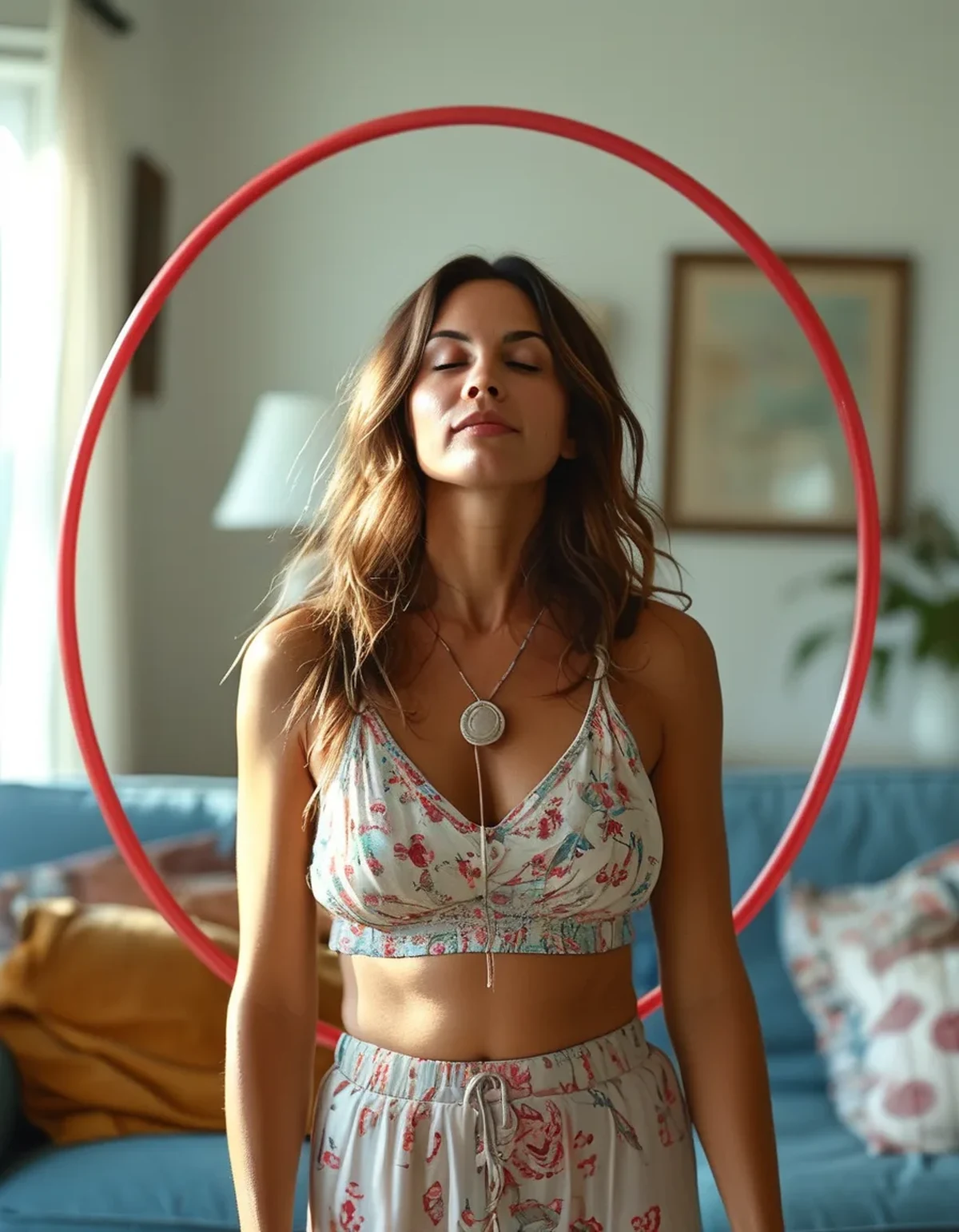
Walking, stepping, and turning while hooping is a substantial coordination achievement.
Static hooping requires only a stable rhythm from a fixed base. Adding footwork means maintaining that rhythm while the base moves, which demands genuine dissociation between upper and lower body.
Progression order that works: shift weight side to side, step in place, walk forwards, walk backwards, turn 180 degrees, turn continuously.
Turning is the hardest of these because it changes your orientation relative to the hoop’s plane and briefly disrupts the visual reference you have been using.
Why this matters for real practice: hooping in a fixed spot is limited by the space you have. Being able to move opens up practising anywhere, and it is the entry point to hoop dance.
5. The same session leaves you less tired
Efficiency improvement is real progress that looks like nothing on paper.
Beginners use far more energy than necessary, over-pumping, tensing the shoulders and arms, and gripping through the whole body. Improvement means producing the same hoop speed with smaller, better-timed movements.
How to notice it: the same duration feeling easier, less shoulder and neck tension afterwards, and being able to hold a conversation while hooping.
Why people misread this as a plateau: if the workout feels easier at the same duration, it is natural to conclude you have stopped progressing. In fact you have improved to the point where the old benchmark is no longer challenging - which is a reason to increase difficulty, not to worry.
What to do with it: add a heavier hoop, a faster tempo, footwork, or trick attempts. Efficiency gains are the signal to raise the demand.
6 and 7: Bruising stopped, and you can hoop in less than ideal conditions
6. Bruising has stopped
The most underrated marker, and the one people are happiest to reach.
Early bruising comes from the hoop repeatedly striking the same spot because the plane is inconsistent and the timing is off. As control improves, contact becomes more even and less forceful, and the bruising resolves.
A caveat: heavier hoops bruise more, so switching to a heavier hoop can bring bruising back temporarily. That is not regression, it is a new tool.
If bruising has not improved after several weeks of consistent practice, the hoop is likely too heavy or too small for your current skill, rather than your technique being the issue.
What ended it, in most cases: the hoop staying more level, contact spreading across a wider area of the torso, and less forceful pumping. All three are technique improvements.
7. You can hoop in less than ideal conditions
Adaptability is the quiet marker that a skill has become durable.
Practising in a small space, on carpet rather than hard floor, in different clothing, or with an unfamiliar hoop all disturb a fragile skill and barely touch a robust one.
Clothing matters more than people expect. Slippery fabrics reduce friction and make the hoop harder to keep up; a hoop that stays up over a satin top is a hoop you genuinely control.
An unfamiliar hoop is the strongest test. Different weight, diameter, and tubing all change the timing. Being able to adjust within a minute or two, rather than being unable to hoop at all, is a substantial skill.
Why this matters practically: it means you can hoop on holiday, at a class, at a friend’s house, with whatever is available. A skill that only works with your hoop, in your room, in your leggings, is a narrower skill than it feels.
How to build it deliberately: occasionally practise in a different room, in different clothes, or with a borrowed hoop. It is uncomfortable and it makes the skill considerably more robust.
How to actually track progress, and FAQ
Keep a monthly benchmark session rather than tracking every practice. Time both directions, count saves, note which tricks you attempted and how many landed. Monthly comparison shows change that daily tracking hides in noise.
Film yourself once a month. Video is far more honest than memory about posture, hoop plane, and how much unnecessary movement you are producing.
Track skills as a list, not a number. “Can walk while hooping” and “can reverse direction without stopping” are milestones. Duration is one metric among many and the least informative after the first month.
Expect an early plateau in duration and treat it as normal. Once you can hoop for a few minutes, further duration gains are largely a fitness question rather than a skill one.
Why has my hooping time stopped improving?
Because duration depends mostly on rhythm and hoop fit, both of which you solve early. After that, improvement shows up as control - recoveries, direction changes, speed control, and footwork - none of which lengthen a timer.
How long should a beginner be able to hoop?
There is no standard, and it varies enormously with hoop size and weight. A larger, heavier hoop rotates more slowly and is substantially easier to keep up, which is why beginner hoops are sized that way.
Should I learn both directions?
Yes, and earlier than feels natural. The weak direction improves overall control, and the gap widens the longer you leave it. Ninety seconds in your weak direction is a genuine achievement worth tracking separately.
Is bruising normal when starting?
Common in the first few weeks, and it should fade as the hoop plane becomes more consistent. Persistent bruising after several weeks usually means the hoop is too heavy or too small rather than a technique problem.
This is general information, not medical advice. Persistent pain, rather than early bruising, is worth having assessed.
TL;DR:
- Duration plateaus early because it depends on rhythm and hoop fit, both solved in the first weeks.
- Saving a falling hoop is a step change in skill and completely invisible on a stopwatch.
- Track your weak direction separately - going from 20 to 90 seconds there is major progress.
- Sessions feeling easier means you have improved, not stalled; raise the demand.
- Hooping with an unfamiliar hoop, in different clothes, in a different room is the real durability test.
You have not plateaued. You have been measuring the one thing that stops changing after month one.
Keep Reading
This article is for general informational and styling purposes only. Fit, sizing, and product availability may vary.