7 Reasons Your Hula Hoop Keeps Falling (It's Rarely About Effort)
Quick Answer: Hula hoops fall most often because of wrong hoop size (too small or too light for an adult beginner), a rocking motion instead of a push, or feet positioned wrong. Fixing hoop size alone solves the problem for most adult beginners before technique even comes into play.
You remember hooping easily as a kid, and now as an adult it drops after two rotations, every single time. That gap isn’t about losing rhythm — it’s almost always one of these 7 specific, fixable issues.

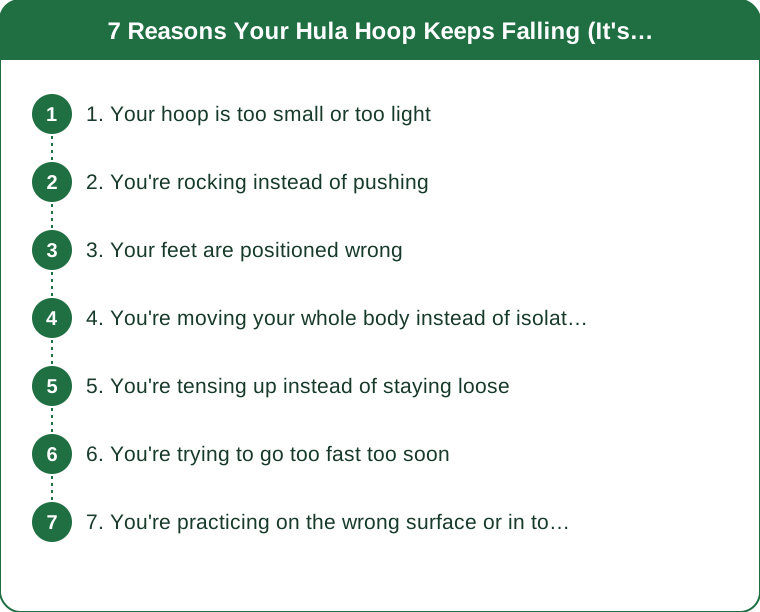
1. Your hoop is too small or too light
Kids’ hoops (and most store-bought ‘fitness’ hoops) are far too small and light for an adult body to generate momentum with. A properly sized adult hoop should reach roughly between your waist and chest when stood on its edge — undersized hoops are the single most common reason adults fail immediately.
2. You’re rocking instead of pushing
Beginners often sway side to side rather than pushing the hoop with a distinct forward-back motion at the hips. The correct motion is closer to a subtle push-catch rhythm — push the hoop forward with one side of your hips, let it come around, catch and push again with the same consistent timing.
3. Your feet are positioned wrong
Standing with feet together or too narrow reduces your base of stability and makes the hip motion harder to control. A slightly staggered stance, one foot a little forward, gives you the balance base the movement actually needs.

4. You’re moving your whole body instead of isolating your hips
Adults especially tend to move their shoulders and upper body along with the hoop, which actually works against the momentum rather than helping it. The goal is a relatively still upper body with the movement isolated at the hips.
5. You’re tensing up instead of staying loose
Gripping and tensing your core and legs while learning restricts the natural motion the hoop needs to keep circling. A relaxed but engaged core allows the small continuous adjustments that keep a hoop up far better than a stiff, braced posture.
6. You’re trying to go too fast too soon
The instinct to push harder when a hoop starts to drop usually overcorrects and knocks it off rhythm entirely. A slower, more controlled push, especially while re-learning, keeps the hoop’s path more predictable and easier to sustain.
7. You’re practicing on the wrong surface or in too small a space
Hooping on carpet (extra friction) or in a cramped space (accidentally hitting furniture, breaking rhythm to avoid obstacles) interrupts the exact continuous motion hooping depends on — a firm, open floor removes this variable entirely.
What size hoop should an adult beginner actually buy?
A hoop reaching somewhere between your waist and lower ribs when stood upright, with some weight to it (not the light plastic toy-store kind), is the standard beginner recommendation.
How long does it typically take an adult to relearn hooping?
Most adults regain basic sustained hooping within a few practice sessions once hoop size and push technique are corrected — much faster than starting from scratch, since the movement pattern is often still partly there from childhood.
Does hula hooping actually work as real exercise, not just a novelty?
Yes — sustained hooping engages core muscles continuously and can provide a genuine light-to-moderate cardio effect, especially with a weighted hoop, once you can sustain it for several minutes at a time.
TL;DR:
- The single most common fix is hoop size — most adults are using one that’s too small or too light
- Push-catch hip motion beats side-to-side rocking, and a staggered stance adds needed stability
- Stay relatively loose and keep the upper body still while isolating movement at the hips
- Slower, controlled pushes outlast the instinct to push harder when it starts to drop
Keep Reading
This article is for general informational and styling purposes only. Fit, sizing, and product availability may vary.