7 Signs You Are Ready to Move Off a Beginner Weighted Hoop
Quick Answer: A heavy, oversized beginner hoop is easy to keep up because its weight and diameter slow the rotation down and give you more time to react. That is exactly what a beginner needs and exactly what blocks progress later. Once waist hooping is genuinely automatic for five minutes in both directions, the heavy hoop is holding you back - and the signs below are the ones that show up first. Lighter and smaller is harder for about two weeks and then opens up everything else.
Seven signals, roughly in the order people notice them.

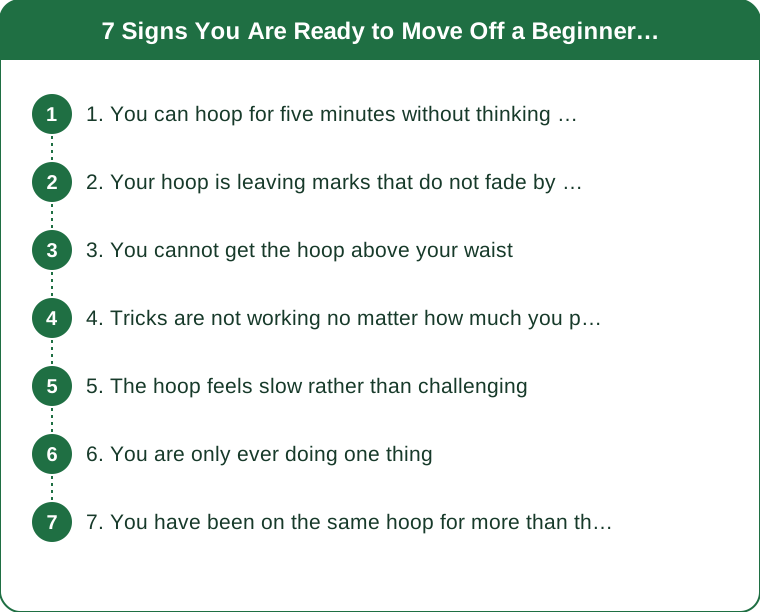
1. You can hoop for five minutes without thinking about it
The benchmark: five continuous minutes at the waist, in both directions, while holding a conversation or watching something.
Why it matters: if the hoop stays up without your attention, you have finished learning what a heavy hoop teaches. Its entire pedagogical value is buying you reaction time, and you no longer need the extra time.
The both directions part is not optional. Almost everyone is significantly better in one direction, and the weaker direction is the honest test. If you can go five minutes in your dominant direction and 40 seconds in the other, you are not ready - you have one trained side and one untrained one, and a lighter hoop will expose that immediately.
Spend two weeks working the weak side back to parity before changing equipment. It is much easier to fix on the hoop you already know.
2. Your hoop is leaving marks that do not fade by evening
The symptom: persistent bruising at the hips or lower back, or soreness that lingers into the next day.
Early bruising is normal for the first two or three weeks with any weighted hoop - the tissue is not used to the repeated contact and it adapts. Persistent bruising after a month is not adaptation, it is too much mass.
The physics: a heavier hoop delivers more force with every rotation. A 1.5kg hoop is a substantially different impact than a 0.6kg one, and the difference is felt most by people with less padding over the hip bones - which is why lean hoopers often need to drop weight sooner than the guidelines suggest.
The test: press gently on the sore area the morning after. If it is genuinely tender to touch rather than just aware, the hoop is too heavy for you regardless of your skill level, and that has nothing to do with toughness.
3. You cannot get the hoop above your waist
The symptom: chest hooping, shoulder hooping, and hand hooping all feel impossible, and the hoop drops immediately when you try to lift it.
This is the clearest single sign, and it is purely equipment. Heavy hoops are almost impossible to raise above the waist because there is too much mass to accelerate and control with the smaller, weaker muscles of the upper body. A 1.5kg hoop on the chest is genuinely difficult for anyone.
What a lighter hoop changes: at 0.4 to 0.6kg, chest and shoulder hooping goes from impossible to merely difficult within a couple of sessions. The entire upper-body half of hooping only exists at lighter weights, which is why hoopers who stay heavy tend to plateau at waist work and conclude they have hit their ceiling.

4. Tricks are not working no matter how much you practise
The symptom: you have watched the tutorials, you understand the mechanics, and the trick simply will not happen.
Why the hoop is usually the reason: tricks depend on changing the hoop’s direction and plane quickly, and momentum is the enemy of quick changes. A heavy hoop has too much of it. Escalators, isolations, breaks and reversals all need a hoop light enough to redirect with a small movement.
The reality check: watch anyone doing hoop dance and look at their hoop. It will be light and relatively small - typically 0.3 to 0.6kg and sized to reach somewhere between the navel and the lower ribs when stood on end. That is not a stylistic preference, it is what the movements require.
If your practice has been flat for two months and you are working from tutorials made by people using a completely different piece of equipment, the problem is not your body.
5. The hoop feels slow rather than challenging
The symptom: you find yourself waiting for the hoop to come around, and your body movement feels like it has to be exaggerated to match.
This is the rotation speed telling you something. A larger, heavier hoop rotates more slowly, so it demands a slower, larger body movement. Once that rhythm feels sluggish, your body has adapted past the equipment.
What changes with a smaller hoop: rotation speeds up, the required body movement gets smaller and faster, and the core engagement changes character entirely - from large slow pushes to quick controlled pulses. Most people describe this as suddenly feeling like a workout again after months of it feeling like maintenance.
Expect a genuine drop in performance for one to two weeks. Everyone who makes this switch drops the hoop constantly for the first few sessions. That is the adjustment, not a sign the change was wrong.
6. You are only ever doing one thing
The symptom: every session is waist hooping for 20 minutes, and you have not added anything new in months.
Heavy hoops are single-purpose tools. They do waist hooping well and almost nothing else. If your practice has become one movement repeated, that is the equipment’s range, not yours.
What opens up at lighter weight:
- Chest and shoulder hooping, which are the natural next step and completely blocked at heavy weights
- Hand and arm hooping, which is where most hoop dance lives
- Off-body work - passes, transitions, and the whole flow vocabulary
- Faster combinations, which need a hoop you can redirect
The boredom is information. People rarely quit hooping because it stopped working. They quit because it stopped changing, and a heavy hoop guarantees it stops changing.
7. You have been on the same hoop for more than three months
The simplest rule, and the one worth applying even if none of the other six quite fit.
Beginner hoops are designed for a learning period of weeks, not for a permanent practice. The manufacturer expectation is that you use it while you learn the fundamental movement and then move on. Very few people actually do, because the beginner hoop keeps working - it just keeps working at the same level.
What to buy next:
- Size: stand the hoop on end. A beginner hoop reaches the chest; your next one should reach somewhere between the navel and the lower ribs
- Weight: drop to roughly half of what you have. If you are on 1.5kg, look at 0.6 to 0.8kg. If you are on 0.8kg, look at 0.4kg
- Change one variable at a time. Going smaller and much lighter simultaneously is a rough two weeks. Drop the weight first, keep the diameter, then size down a month later
- Keep the old hoop. It is genuinely useful as a warm-up and for the days when you want the workout without the coordination demand
What nobody tells you: the transition feels like going backwards, and for about ten days it genuinely is. Then the tricks that were impossible start working within a single session, and that is the moment people realise the plateau was never about them.
TL;DR:
- Five automatic minutes in both directions means the heavy hoop has taught you everything it can
- Bruising past the first month, and any inability to hoop above the waist, are equipment signals not skill ones
- Tricks need a hoop light enough to redirect - typically 0.3 to 0.6kg, navel to lower rib height
- Expect one to two weeks of dropping the hoop constantly; that is the adjustment, not a mistake
- Change one variable at a time - weight first, then diameter a month later
If your hooping has been flat for months, look at the hoop before you look at your practice. A plateau on a beginner hoop is usually a plateau in the equipment, and it costs about the price of a coffee round to test that theory.
Keep Reading
This article is for general informational and styling purposes only. Fit, sizing, and product availability may vary.