7 Signs You're Using the Wrong Hula Hoop for Your Body
Quick Answer: A hula hoop that’s too small or too light for your body is the most common reason beginners can’t keep it up — not lack of coordination. The right beginner hoop should reach roughly between your waist and chest when stood on its edge.
You’ve watched tutorials, practiced the hip motion, and the hoop still drops after two rotations. Before blaming your technique, check whether the hoop itself is working against you — these 7 signs usually mean it is.

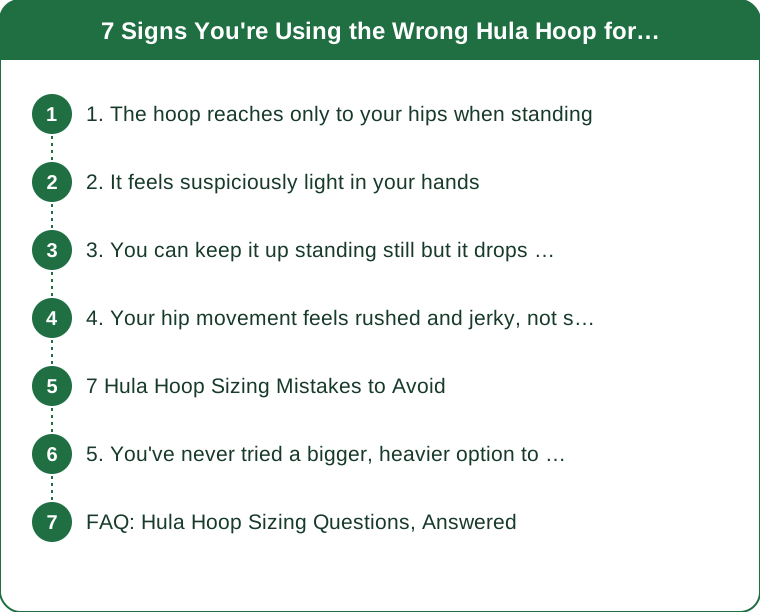
1. The hoop reaches only to your hips when standing
A properly-sized beginner hoop, stood upright next to you, should reach somewhere between your belly button and chest. If it only comes up to your hip bones, it’s too small — smaller hoops spin faster and require more advanced timing that beginners haven’t built yet.
2. It feels suspiciously light in your hands
Weight matters as much as diameter. A too-light hoop (common in kids’ or cheap adult hoops) moves faster than beginner reflexes can track, making it feel like you’re chasing the hoop instead of guiding it. A beginner hoop should have noticeable heft — you should feel its momentum, not have to fight to feel it at all.
3. You can keep it up standing still but it drops the second you try to move
This usually isn’t a technique gap — it’s that the hoop’s size and weight only barely work for stationary hooping and have zero margin for the added complexity of travel or dance. A properly-sized hoop gives you enough rotational time to also shift weight and move your feet.

4. Your hip movement feels rushed and jerky, not smooth
If you feel like you’re constantly playing catch-up with quick, jerky hip pops, that’s a strong signal the hoop is too small and spinning faster than your body’s natural rhythm. A correctly sized hoop gives a slower rotation that matches a more natural hip sway — smooth, not frantic.
7 Hula Hoop Sizing Mistakes to Avoid
1. Judging size by what looks proportional, rather than measuring against your actual body — visual proportion is misleading. 2. Buying the cheapest hoop available, which is almost always too light for adult beginner use. 3. Assuming kids’ hoops from childhood will still work — they were sized for a much smaller body. 4. Skipping the polypro/HDPE weight difference — same size hoops can vary significantly in actual heft between materials. 5. Not accounting for torso length, which affects the ideal size more than total height does. 6. Buying a fixed-size hoop before knowing if you’ll enjoy the hobby — an adjustable hoop lets you test different sizes first. 7. Downsizing too fast once basic hooping clicks — give yourself weeks at the beginner size before going smaller.
5. You’ve never tried a bigger, heavier option to compare
Many people troubleshoot everything except the hoop size itself, because it feels like ‘starting over’ to size up. But trying one class or one loaner hoop a size larger is the fastest diagnostic — if keeping it up suddenly feels dramatically easier, size was the problem all along, not coordination.
FAQ: Hula Hoop Sizing Questions, Answered
What size hula hoop should a beginner adult use?
Generally 38-42 inches in diameter for adults, reaching between waist and chest height when stood upright, in a weighted (not kids’) hoop.
Should I size down once I get better at hooping?
Yes, eventually — smaller, lighter hoops allow faster tricks once fundamentals are solid. Most experienced hoopers work down gradually over months, not weeks.
Can a hula hoop be too big?
Less common than too small, but yes — an oversized hoop for your torso length can feel unwieldy and slow to control, especially for waist-level tricks. Reaching mid-chest is generally the upper useful limit for beginners.
TL;DR:
- A beginner hoop should reach between your waist and chest when stood upright next to you
- Weight matters as much as size — too-light hoops spin faster than beginner reflexes can track
- If it stays up standing still but drops the moment you move, the hoop likely has zero size margin
- Borrow a bigger hoop once to test — if it’s suddenly easier, sizing was the real issue all along
Before doubting your coordination, doubt the hoop — sizing solves more hula hoop struggles than technique practice ever does.
Keep Reading
This article is for general informational and styling purposes only. Fit, sizing, and product availability may vary.