7 Ways Clothing Changes How Your Hoop Behaves
Quick Answer: A hoop stays up because of friction between the hoop and your torso plus a correctly timed push. Clothing changes the friction directly - slick synthetics can cut it by more than half, while cotton and ribbed knits increase it. Layers also add bulk that changes the effective diameter of your waist, move the contact point, and let the fabric slide independently of your body, so your push transfers to the shirt instead of the hoop. The result is a hoop that behaves like a different hoop. The fixes are fabric choice and a fitted base layer, not more effort.
You could hoop for ten minutes straight in August. First cool week, you put on a long sleeve top and the hoop is on the floor in fifteen seconds.
Seven distinct mechanisms are at work, and six of them are about what you are wearing.
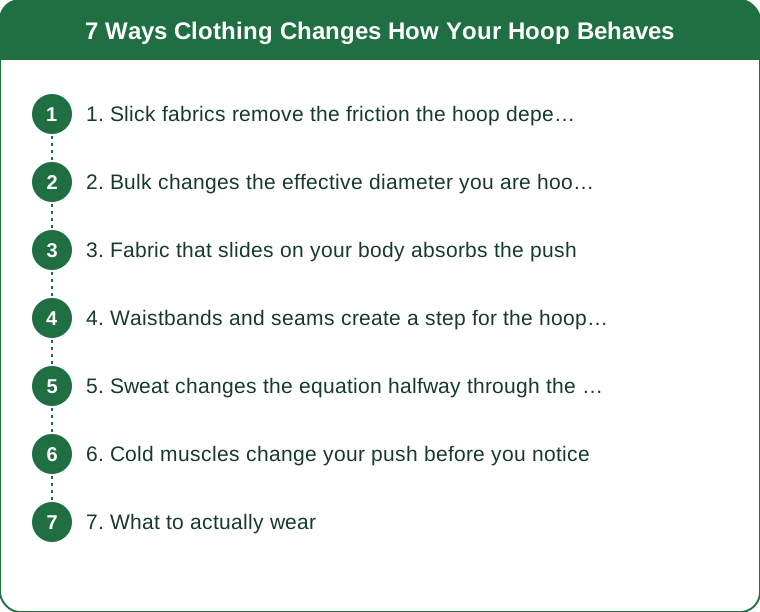
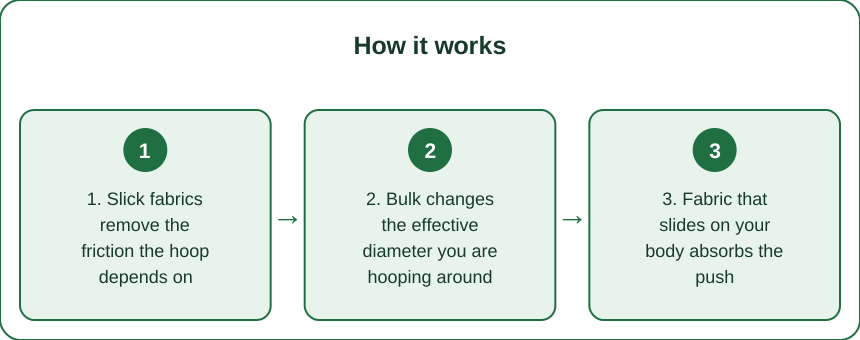
1. Slick fabrics remove the friction the hoop depends on
This is the largest single factor and the easiest to test.
A hoop stays up because each rotation, your body pushes it forward and friction between the hoop and your clothing prevents it sliding downward while gravity works on it. That friction is doing continuous work.
Smooth synthetics - polyester shells, nylon, satin finishes, slick performance fabrics - have a substantially lower coefficient of friction against a plastic or padded hoop than cotton or a textured knit does. The hoop slides down the fabric rather than being carried around by it.
The test takes thirty seconds: try the same hoop against bare skin, then in a cotton t-shirt, then in a slick athletic top. The difference is usually dramatic and it immediately reframes the problem from technique to wardrobe.
Ranking, roughly best to worst for grip: ribbed cotton and textured knits, plain cotton jersey, bare skin, brushed fleece, smooth polyester, satin or nylon shells.
Bare skin is in the middle rather than at the top, which surprises people - it grips well when dry and poorly once you sweat, which is why a session that starts well can degrade at minute six.
The practical answer: keep one cotton or ribbed top as your designated hooping layer. It is a cheaper fix than a new hoop and it makes a bigger difference.
2. Bulk changes the effective diameter you are hooping around
Adding two layers can add several centimeters to your waist circumference, and the hoop notices.
Hoop size selection is based on your body. A larger effective waist means the hoop travels a longer path per rotation and rotates more slowly at the same push rate - and a slower hoop falls, because the outward force keeping it against you is a function of rotational speed.
A bulky fleece or a padded layer can easily add three to five centimeters of diameter, which is not trivial relative to the tolerance most people are working within.
Confusingly, the effect can go either way. For a beginner using a hoop that is slightly too small, added bulk can genuinely help. For anyone whose hoop is correctly sized, it makes things worse. Which one you are explains why some people find bulky layers easier.
Bulk also softens the contact. A thick compressible layer absorbs some of the push you deliver, in the same way that punching a pillow transfers less than punching a wall. You are doing the same work and less of it is reaching the hoop.
The fix is a fitted base rather than a thin one. A close-fitting long sleeve top in a cotton or cotton-blend knit gives you warmth without bulk and without slickness. Layer bulk over the top only outside of the contact zone - a fitted torso with a looser upper layer that ends above the waist works fine.
3. Fabric that slides on your body absorbs the push
A loose top moves independently, and your push goes into the shirt instead of the hoop.
The hoop push comes from a small, fast weight shift of the torso. That impulse has to transfer through whatever is between your body and the hoop. If the layer can slide over your skin, some of the impulse goes into moving the fabric rather than the hoop.
This is why a loose t-shirt is often worse than either a fitted top or bare skin, despite cotton having good friction against the hoop. Cotton grips the hoop well and then slides on you.
The tell is visual. Film ten seconds on your phone: if the shirt is visibly moving around your torso while the hoop is dropping, the layer is the problem, not the timing.
Tucking helps and is underrated. A tucked-in top cannot ride and cannot slide as freely, and tucking alone frequently fixes a hoop that was dropping with the same shirt untucked.
A fitted base layer under a loose top is the general solution - the fitted layer handles the contact, the loose layer handles the warmth, and the hoop only ever interacts with the fitted one if the outer layer is short enough.
4. Waistbands and seams create a step for the hoop to fall off
Any horizontal ridge at the contact height gives gravity a place to work.
The hoop rides at a specific height on the torso, usually somewhere between the navel and the lower ribs. Anything creating a step at or just below that height - a thick waistband, a hem, a folded layer, a drawcord - gives the hoop an edge to slip over.
Once it drops below that edge, it is at a wider part of the body path and it accelerates downward.
High rise leggings with a thick band are the most common offender, because the top of the band frequently sits exactly in the hoop’s contact zone.
Two fixes. Either move the waistband out of the zone - a mid rise bottom, or wearing the high rise band under a tucked-in top so the surface is continuous - or make the transition smooth by covering the step with a fitted layer.
Jacket hems and hoodie kangaroo pockets are the other common one. A hoodie pocket is a raised horizontal ridge with an opening at the top, and it will catch a hoop repeatedly. Nothing with a front pocket, for hooping.
And check the back. Bra bands, layered hems and bunched fabric behind you produce the same effect, and because you cannot see it, it is the version people troubleshoot for weeks.
5. Sweat changes the equation halfway through the session
Grip is not a constant - it degrades over the first ten minutes and the fabric determines how fast.
Bare skin grips well when dry. As soon as a film of sweat forms, the coefficient of friction drops considerably and the hoop starts sliding. This is the mechanism behind the common experience of hooping well for five minutes and then falling apart.
Fabric choice determines how this plays out. Cotton absorbs sweat and maintains grip for longer, but eventually becomes saturated, heavy and slick. Merino and cotton blends handle the middle of a session best. Slick synthetics start bad and get worse, because the sweat sits on the surface rather than being absorbed.
Indoor heating makes this arrive faster in autumn than it did in a cool summer room, which is a genuinely counterintuitive result - people expect autumn hooping to be less sweaty.
The practical response is a mid-session top change on longer sessions, or a designated cotton hooping shirt that you accept will be damp. A towel wipe of the hoop itself helps too - the hoop surface picks up moisture and skin oils, and a wipe restores grip immediately.
Clean the hoop periodically. Accumulated body oil on the inner surface of a hoop is a real and gradual grip loss that people almost never diagnose, because it happens too slowly to notice.
6. Cold muscles change your push before you notice
The one item on the list that is not about clothing.
The hoop push is a rapid, small-amplitude weight shift requiring coordination and timing. Cold muscle is stiffer, contracts slightly more slowly, and proprioception is measurably reduced in cool conditions.
The practical consequence is that your timing is slightly late and your amplitude is slightly large - both of which cause exactly the wobble-then-drop pattern that reads as a technique problem.
In a cool autumn room, the first two or three minutes of hooping are warm-up, not practice. Judging a session by the first two minutes will produce a pessimistic and inaccurate verdict.
Warm up before you start hooping, not with the hoop. Two minutes of torso rotations, hip circles and marching raises tissue temperature enough that the first attempt is representative.
This also explains the common pattern of dropping constantly at the start of an autumn session and then hooping fine twenty minutes in. Nothing improved except your muscle temperature.
7. What to actually wear
One outfit that removes six of the seven problems.
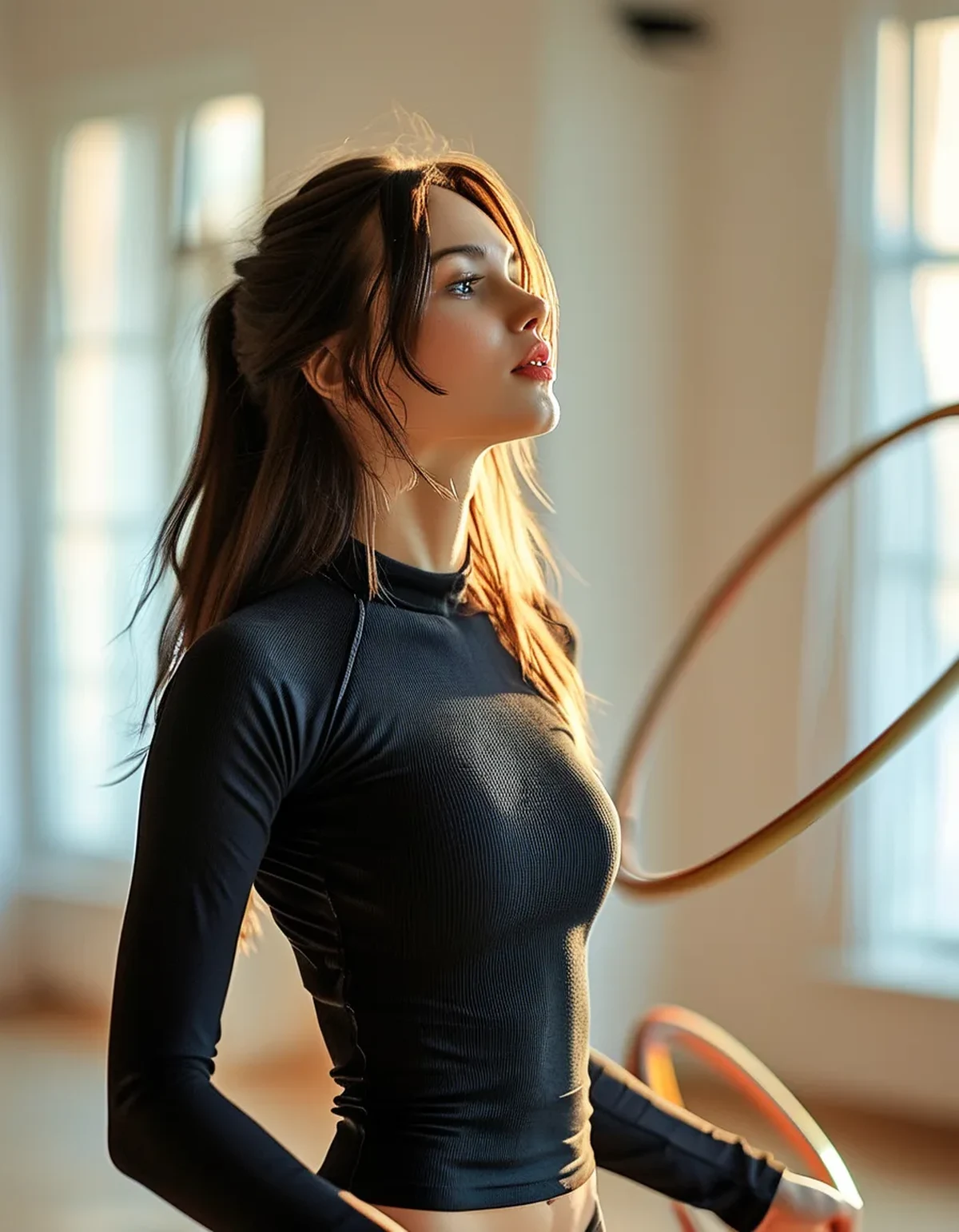
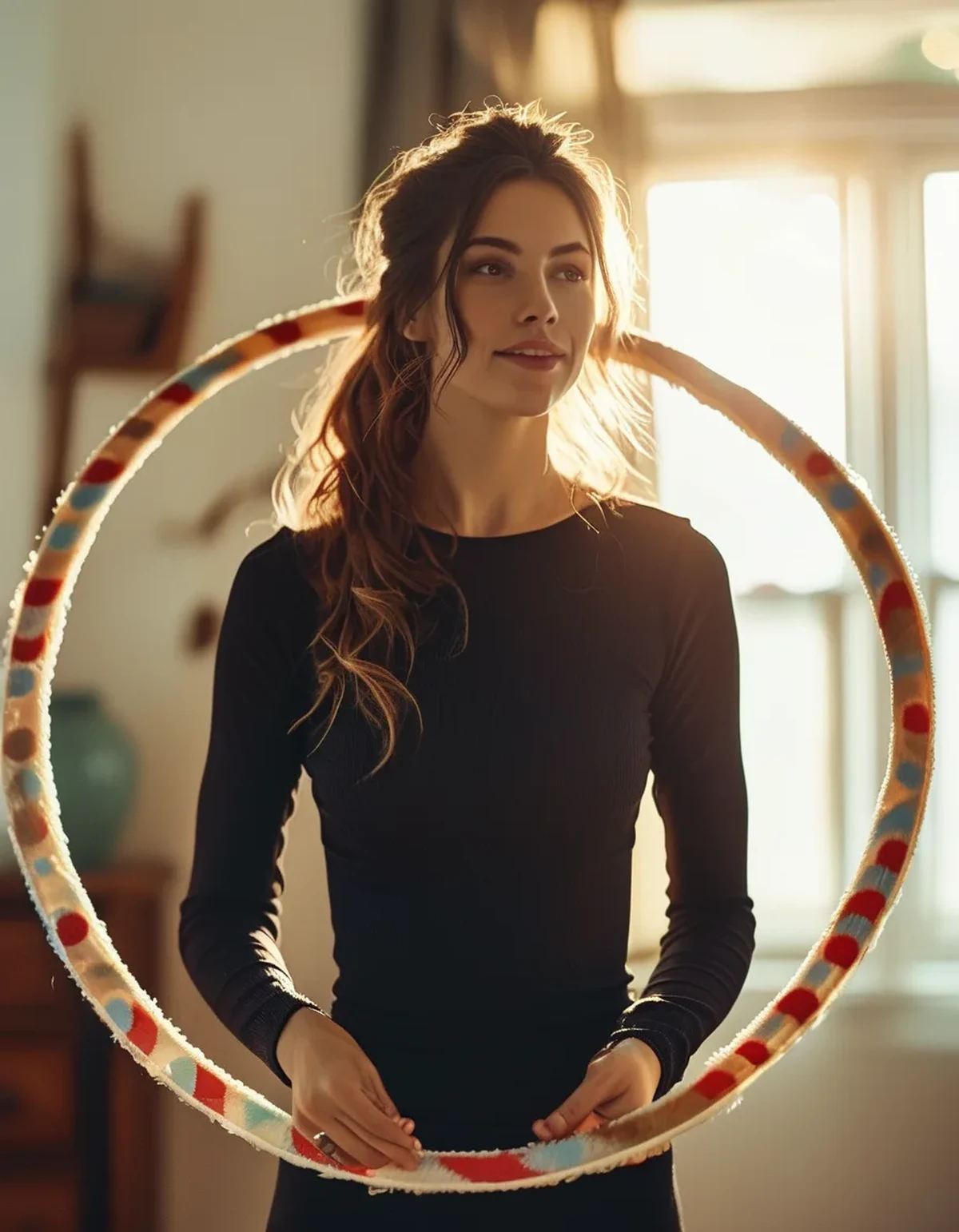
A fitted cotton or cotton-blend long sleeve top, tucked in, with no front pocket, no hem at hoop height and no bulky seams. That single garment addresses friction, slide, bulk and the step problem simultaneously.
Mid rise bottoms, or high rise worn under the tucked top so the waistband is not exposed at the contact zone.
Layer for warmth above and below the contact zone rather than across it. A cropped fleece or a jacket you remove after warming up. Leg warmth is free - nothing below the hips affects hooping at all.
Keep a towel and wipe the hoop at the halfway point of any session over ten minutes.
And if you have been fighting a hoop that keeps dropping since the weather turned, change the shirt before you change anything else. It is the fastest diagnostic available - one session in a fitted cotton top will tell you within two minutes whether the last three weeks of frustration were technique or wardrobe.
Bruising note: if adding layers has coincided with more bruising, that is usually a sign you are compensating with a harder push. Padding should reduce bruising, and if it has not, the force has gone up. Persistent bruising that does not settle with technique changes is worth a mention to a clinician, and this is general information rather than medical advice.
TL;DR:
- Slick synthetics cut hoop friction dramatically. Ribbed and plain cotton grip best; satin and nylon are the worst.
- Bulk enlarges your effective waist, slowing the hoop, and compressible layers absorb the push.
- A loose top slides on you and eats the impulse - tuck it in or wear a fitted base.
- Thick waistbands, hems and hoodie pockets create a step for the hoop to fall over.
- Grip degrades with sweat and indoor heating brings that on faster than a cool summer room did.
- Cold muscles make your timing late. The first three minutes are warm-up, not evidence.
- Fitted cotton long sleeve, tucked, no front pocket, mid rise bottoms. That is the outfit.
Change the shirt before you change the hoop.
Keep Reading
This article is for general informational and styling purposes only. Fit, sizing, and product availability may vary.