7 Signs You're Using the Wrong Size Hula Hoop
Quick Answer: A hula hoop that’s too small or too light is the number one reason beginners struggle to keep it up, since smaller, lighter hoops spin faster and require more advanced timing — beginners generally do better starting with a larger, heavier hoop than intuition suggests.
Most people assume hula hooping struggles come down to core strength or rhythm, when the actual hoop size and weight is very often the real problem.

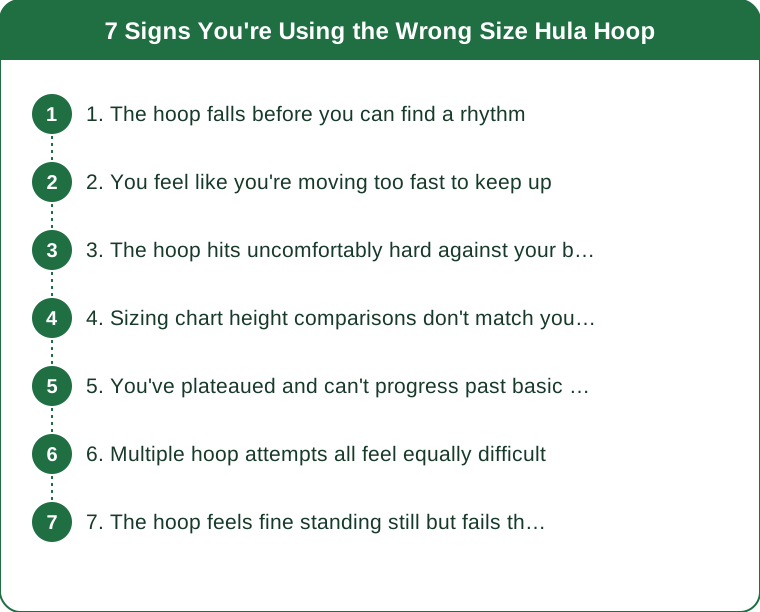
1. The hoop falls before you can find a rhythm
If the hoop drops within a rotation or two consistently, it’s often too small or too light for a beginner’s timing window — a bigger, heavier hoop moves slower around the body, giving you more time to react and adjust with each rotation.
2. You feel like you’re moving too fast to keep up
Beginner hoops should feel almost slow-motion compared to the fast, small hoops used by advanced performers. If your hoop feels frantic to keep pace with, sizing up is the fix, not more practice at the same size.
3. The hoop hits uncomfortably hard against your body
A too-light hoop moving too fast can sting on contact, which is both uncomfortable and a sign the size or weight isn’t matched to your current skill level. A properly weighted hoop makes contact feel more like a gentle push.

4. Sizing chart height comparisons don’t match your actual experience
General height-based hoop size charts are a starting point, not a rule — torso length and current skill level matter as much as overall height. If a chart-recommended size still feels too fast, it’s fine to size up further.
5. You’ve plateaued and can’t progress past basic waist hooping
As skills advance, smaller, lighter hoops become appropriate and even necessary for tricks and off-body moves — sticking with an oversized beginner hoop indefinitely can eventually limit your progression once basics are solid.
6. Multiple hoop attempts all feel equally difficult
If several different hoops all feel similarly hard to manage, the issue may not be sizing at all but fundamental technique — hip movement direction and timing matter independent of hoop size, so a technique check is worth doing alongside a size check.
7. The hoop feels fine standing still but fails the moment you move
This often points to weight distribution issues rather than overall size — a hoop that’s unevenly weighted or made from inconsistent tubing can behave unpredictably in motion even if the diameter is correct for your body.
TL;DR:
- A hoop that’s too small or light spins too fast for beginners to manage
- Beginner hoops should feel noticeably slower and heavier than performance hoops
- Use height-based sizing charts as a starting point, not a strict rule
- As skill improves, sizing down becomes appropriate for more advanced tricks
If you’ve been struggling and blaming your coordination, trying a larger, heavier hoop before anything else is worth testing first.
Keep Reading
This article is for general informational and styling purposes only. Fit, sizing, and product availability may vary.