Why Hula Hooping Outdoors Feels Completely Different From Hooping Indoors
Quick Answer: Wind disrupts a hoop’s rotation path more than most people expect, uneven or soft ground changes how your feet plant and push, and having more open space changes how confidently you can move while hooping — all of which make outdoor practice feel meaningfully different from a flat indoor floor.
A hoop routine that felt smooth and automatic in the living room can suddenly feel clumsy in the backyard, and it’s rarely about skill regressing.

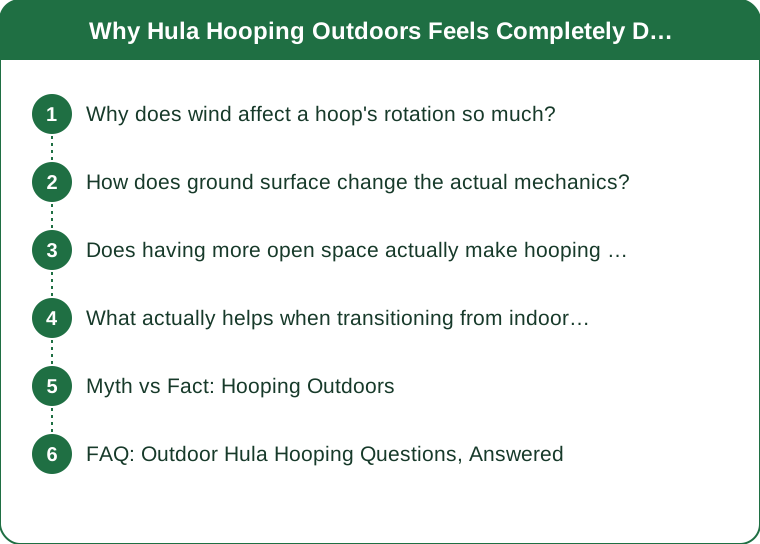
Why does wind affect a hoop’s rotation so much?
A hula hoop relies on a consistent, predictable rotation path to stay up, and even a light breeze can push against the exposed side of the hoop enough to throw off timing — indoors, that variable simply doesn’t exist, which is part of why the same push feels reliable inside and unpredictable outside.
How does ground surface change the actual mechanics?
Grass, sand, or uneven pavement changes how firmly and evenly your feet plant with each push, and softer surfaces absorb a bit of the energy a hard indoor floor would return more directly — this can make the torso-driven push feel less responsive until you adjust for it.
Does having more open space actually make hooping easier or harder?
Both — more space removes the worry of hitting furniture or walls, which can make movement feel freer, but it can also remove the visual reference points (a wall, a rug edge) that indoor spaces provide for staying centered and oriented while hooping.

What actually helps when transitioning from indoor to outdoor practice?
- Choose a calmer, low-wind time of day for the first few outdoor sessions
- Pick the flattest, firmest patch of ground available, rather than soft grass or sand at first
- Expect a short adjustment period rather than assuming skill has regressed
Myth vs Fact: Hooping Outdoors
Myth: If you can hoop well indoors, outdoor conditions shouldn’t matter. Fact: Wind and surface genuinely change the mechanics, regardless of indoor skill level.
Myth: Grass is an easier, softer surface for beginners to practice on. Fact: Grass and uneven ground actually make foot planting and push timing less predictable than a firm indoor floor.
Myth: More space always makes hooping feel easier. Fact: Open space can remove helpful visual reference points that indoor rooms provide, at least at first.
FAQ: Outdoor Hula Hooping Questions, Answered
Is it better to learn hula hooping indoors first before trying outside?
Many people find it easier to build the base mechanics indoors first, then adjust to wind and surface changes once the fundamentals feel automatic.
What wind conditions make hooping outside genuinely difficult?
Noticeable, gusty wind (not just a light breeze) is where most people start finding outdoor hooping meaningfully harder than indoor practice.
Does a heavier hoop help with outdoor wind resistance?
A heavier hoop is generally less affected by wind than a very light one, since more mass resists being pushed off its rotation path.
TL;DR:
- Wind disrupts a hoop’s rotation path in a way indoor spaces never test
- Grass and uneven ground change how your feet plant and push
- More open space can remove helpful indoor reference points
- A short adjustment period outdoors is normal, not a sign of lost skill
The hoop and the person are the same — the environment is what actually changed.
Keep Reading
This article is for general informational and styling purposes only. Fit, sizing, and product availability may vary.